Reimagining Software Quality: The Rise of AI-Powered Governance
Executive Summary
In high-velocity production environments, traditional software testing can become a bottleneck. Based on Parser’s experience driving enterprise-scale transformations, moving from manual-heavy, reactive “hero culture” to a predictable, AI-augmented quality ecosystem is a strategic necessity.
Our goal is not simply to automate more tests. It is to govern quality across the software development lifecycle (SDLC): establish clear accountability, base release decisions on objective evidence, and use AI to strengthen verification without surrendering human oversight.
Grounded in continuous delivery principles pioneered by Jez Humble and David Farley, and aligned with DORA metrics (Deployment Frequency, Lead Time for Changes, Change Failure Rate and Time to Restore Service), this article outlines a practical framework for reducing the Cost of Quality while maintaining delivery velocity and system reliability.
1. The Foundations of Quality Governance
Sustainable quality begins with systematic accountability across the entire organisation. In Parser’s work partnering with large enterprises, establishing a modern executive governance model serves as the cornerstone of engineering operational stability, ensuring that speed and innovation do not come at the cost of technical debt or system vulnerability. Adopting proven continuous delivery principles and DORA-aligned performance indicators, these five principles provide a foundation for governing quality throughout the SDLC:
- Accountability over Activity. Every SDLC stage requires a single, clearly designated owner. Activity without accountability creates friction and risk.
- Quality Gates over Guidelines. Moving between stages is strictly conditional upon satisfying objective criteria at mandatory quality gates.
- Single Source of Truth (SSOT). Select the tool that serves as the ultimate system of record. Ad-hoc or off-system requests are strictly converted into tracked backlog items. If it is not in the system, it does not exist.
- Data-Driven Decisions. Subjective perceptions are replaced by quantifiable governance metrics and KPIs.
- Shift-Left Testing. Testing responsibilities move earlier into the development process, involving the entire engineering team from inception. Catching architectural flaws and requirement ambiguities early reduces defect remediation costs exponentially.
Establishing accountability
Before adopting this governance model, teams need to establish foundational prerequisites: basic version control, defined SDLC stages, and a centralised system of record. Adoption can be incremental. Teams with lower QA maturity can begin with clear ownership and simple gates; more mature teams can introduce automated, AI-driven validation. Managing the cultural shift requires transparent leadership communication, structured training, and framing quality as a shared team accountability rather than an isolated QA task.
To drive clarity, minimise ambiguity, and ensure seamless operational stability, key roles across cross-functional engineering teams must have explicit, non-overlapping ownership. Without clear accountability, governance breakdowns lead to friction, unassigned technical debt, and delayed release cycles. Assigning distinct responsibilities establishes a firm system of record for operational quality and keeps velocity high.
2. Governing Quality Across the SDLC
Integrating AI into mandatory quality gates transforms how teams validate software at each phase, embedding continuous verification directly into daily development workflows. Operationalising these controls is strategically vital to prevent quality degradation as release velocity increases, allowing leadership to maintain structural oversight without introducing manual bottlenecks.
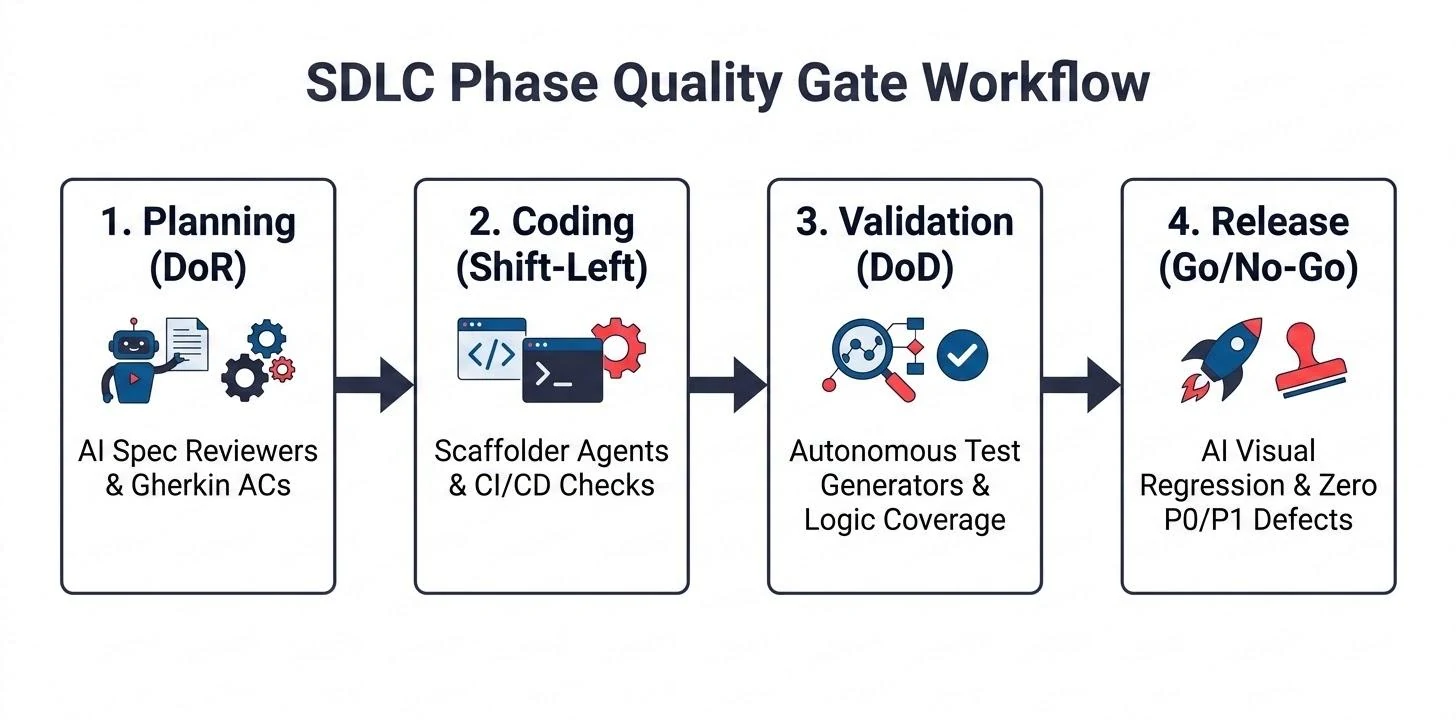
Planning (DoR Gate). In the initial Planning stage, achieving a strict Definition of Ready (DoR) is essential for shifting quality left and preventing requirement ambiguity from cascading into technical debt. Specialised AI Spec Reviewers analyse backlog items, refine Acceptance Criteria into standardised Gherkin format, and suggest complex edge or negative cases before development begins. By establishing clear business context, identifying cross-team dependencies, and conducting rigorous testability checks up front, teams ensure that only fully refined user stories enter active sprints, keeping lead time for changes predictable and minimising downstream delivery friction.
Coding (Shift-Left Design). During the Coding phase, shift-left principles are embedded directly into continuous integration workflows to maintain codebase health and high delivery throughput. Autonomous Scaffolder Agents automatically generate compliant unit test boilerplate, integration test templates, and pull request descriptions upon ticket activation. Pull request merges are strictly gated in CI/CD pipelines, automatically blocking code integration if unit or integration tests fail or if static code analysis checks (e.g. via SonarQube) detect maintainability issues or coverage gaps. This automated feedback loop aligns with continuous delivery best practices, significantly increasing deployment frequency while preserving system integrity.
Validation (DoD Gate). The Validation stage enforces a rigorous Definition of Done (DoD) to guarantee that all functional and non-functional requirements are fully verified. Autonomous AI Test Generators create comprehensive unit test suites and validate intricate corner cases to achieve maximum logic coverage alongside automated end-to-end user flows. Every test output is tied back to the centralised Single Source of Truth, maintaining complete requirement-to-release traceability. Verifying acceptance criteria and logic prior to release candidates stabilises the environment and optimises DORA metrics like Change Failure Rate and Time to Restore Service.
Release (Go/No-Go Gate). At the final Release Go/No-Go gate, autonomous quality checks provide executive visibility and guarantee production readiness. AI-powered visual regression layers inspect application interfaces to detect pixel-level anomalies across multiple browsers and device configurations, complementing automated performance load testing and SAST/DAST security scans. Enforcing strict release criteria, including zero open P0/P1 defects, verified audit trails, and formal QA sign-off, protects enterprise operations from post-release defect leakage while enabling safe, high-velocity deployments.
The following diagram illustrates the SDLC Phase Quality Gate Workflow, detailing the specific governance checks, automated controls, and AI capabilities applied across each phase from planning through release:
3. A Layered Testing Strategy
AI-powered governance depends on comprehensive verification. To maintain structural resilience and mitigate risk across complex ecosystems, software testing must be organised across multiple complementary layers. Relying on a single testing strategy creates blind spots, whereas a multi-tiered hierarchy ensures early defect detection, guards against critical functional regressions, and validates performance under load. Adopting standardised testing models aligned with established industry frameworks, such as the ISO/IEC/IEEE 29119 software testing standard [1], ensures comprehensive verification across all lifecycle stages.
“This test strategy defines the multi-level (Unit, Integration, E2E) and multi-type (Functional, Usability, Performance, Security) dynamic testing sub-processes utilized across the development lifecycle.” ISO/IEC/IEEE 29119 [1]
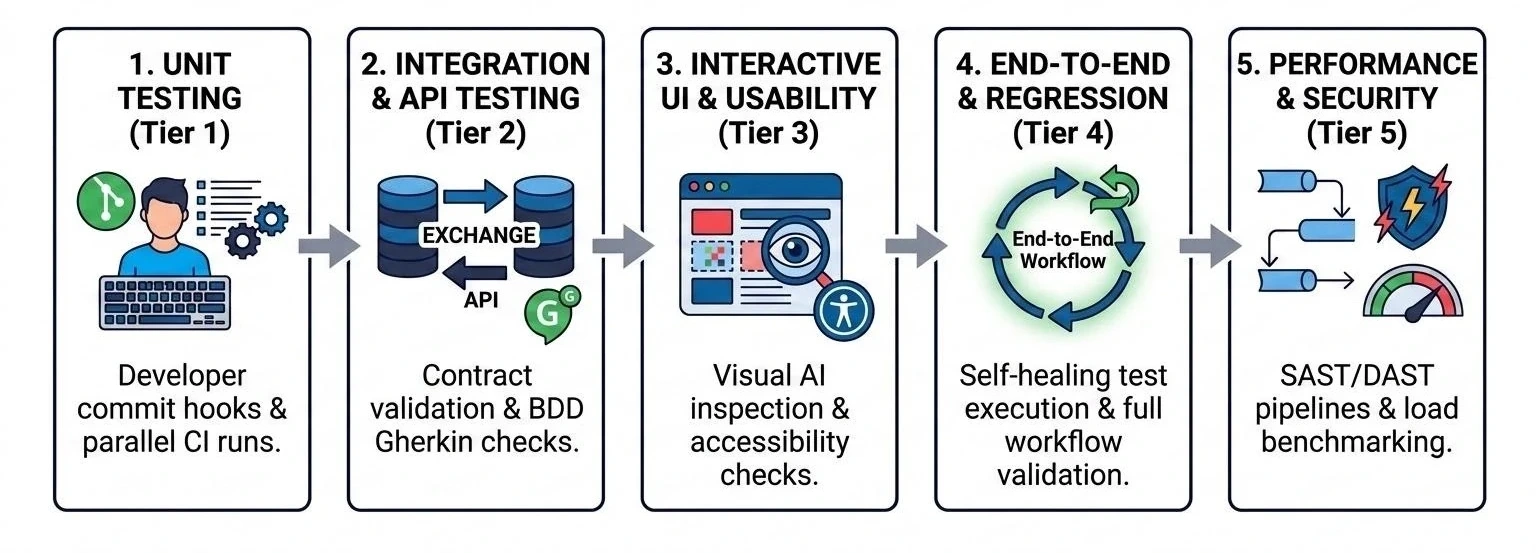
Unit Tests. Developers maintain high coverage over core logic prior to pull request approval. Embedded directly into continuous integration pipelines, unit testing validates isolated software components against functional specifications, preventing localised defects from propagating into higher environments. Minimal unit test automation for every implemented feature serves as a non-negotiable entry criterion for service-layer validation.
Integration Tests. API and service-layer interactions are systematically validated using shared Behaviour-Driven Development (BDD) Gherkin scenarios to verify contract integrity across microservices, databases, and third-party dependencies. Executed continuously during development, integration suites must pass completely before code is promoted to Staging or QA environments.
Interactive & Usability Tests. Early prototype and pre-alpha user interface checks are conducted collaboratively by Designers, Product Managers, and QA Specialists. By evaluating usability, accessibility standards, and core feature flows prior to full QA cycles, teams fulfil Definition of Ready criteria and address design flaws before costly code hardening occurs.
E2E & UI Testing. Fully automated end-to-end user journeys with proper tooling exercise complete workflows from UI layers down to backend APIs, ensuring critical user paths remain unbroken.
Exploratory & Regression Testing. Structured manual exploratory testing uncovers unexpected edge cases and unscripted user behaviours, complementing automated regression suites that verify system stability across key business scenarios.
Performance & Security Scans. Automated Static and Dynamic Application Security Testing (SAST/DAST) in CI/CD pipelines, combined with load and stress testing in a Staging environment, ensures non-functional resilience. Continuous security evaluation and performance benchmarking protect enterprise assets against vulnerabilities and stress failures prior to production deployment.
The governance value of this hierarchy comes from connecting results to requirements and risks, not merely counting tests or maximising coverage. The following diagram illustrates the multi-layered testing strategy, highlighting the automated pipeline integration and AI-driven quality gates enforced at each tier of the testing hierarchy:
4. Governing AI Quality and Automation
AI in engineering pipelines needs its own controls. Machine-generated code, tests, and recommendations must be verified against enterprise requirements before they are trusted or used as release evidence. Architecting an automated AI quality control pipeline forms the technical foundation for autonomous testing, mitigating risk and ensuring that machine-generated code and test suites meet enterprise compliance standards.
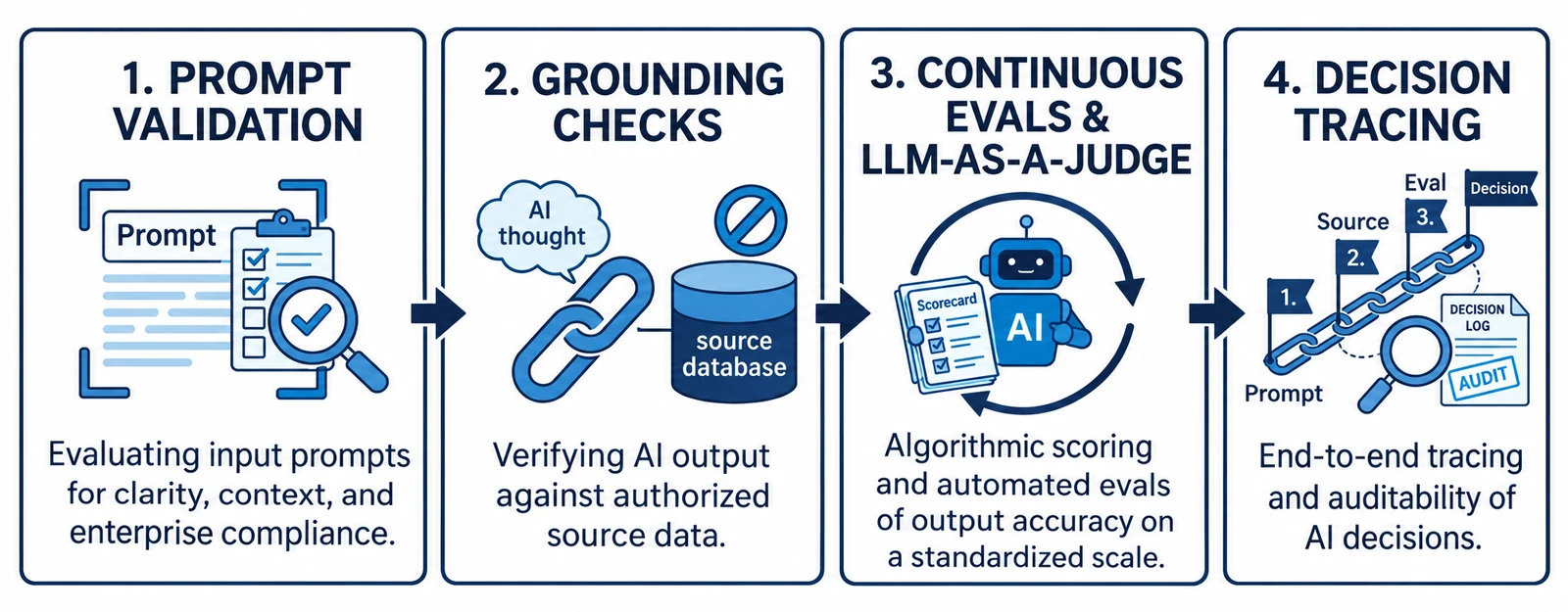
The AI quality-control pipeline described in this framework includes:
- Prompt Validation. Structuring instructions to eliminate ambiguity and systemic bias.
- Grounding Checks. Enforcing zero-hallucination policies where AI outputs are anchored strictly in provided context data.
- Continuous Evals and LLM-as-a-Judge. Scoring output quality, accuracy, and tone on a standardised scale. Secondary AI evaluators continuously benchmark primary model performance to ensure continuous adherence to high standards.
- End-to-End Decision Tracing. Capturing comprehensive audit trails and execution traces for every AI-driven quality gate decision to ensure total transparency and debuggability.
AI evaluation should complement, not replace, engineering review and release accountability. When an AI capability performs below agreed thresholds, targeted diagnostics should investigate prompt grounding and context retrieval. If the problem persists or affects critical delivery pathways, the capability should be temporarily disabled or returned to human-in-the-loop validation until it has been corrected and re-benchmarked.
The following diagram illustrates the AI Quality and Automation Governance Pipeline, highlighting key QA practices such as rigorous evaluations (evals) and end-to-end decision tracing across every stage of machine-generated code validation:
Autonomous Infrastructure, Tooling & Execution Frameworks
The modern enterprise engineering stack leverages advanced automation components, autonomous agentic workflows, and self-correcting integration testing frameworks to maintain continuous quality at scale:
Self-Healing CI Pipelines. Automated healer agents detect broken web locators, take snapshot diffs, and submit dynamic patch PRs without stopping deployments.
Design-to-Test Pipeline. Direct translation of Figma designs into executable test suites prior to code implementation.
A Consistent Toolset. Standardised tooling across web, mobile, unit testing, and static analysis ensures consistent metrics, streamlined automation workflows, and shared quality standards across teams.
5. Measuring Success: Governance Scorecards and AI Metrics
A robust measurement framework provides executive visibility into overall software health, ensuring that quality KPIs directly align with organisational strategy and continuous improvement goals. Governance must be supported by transparent thresholds that mandate concrete actions when breached.
Establishing concrete thresholds and automated governance triggers is essential for maintaining operational integrity across engineering teams. These quantifiable metrics act as objective guardrails, ensuring that quality standards are consistently enforced and preventing gradual degradation as release velocity increases.
The thresholds below have already been applied as success criteria across our client engagements:
| Measure | Threshold | Governance response |
|---|---|---|
| DoR compliance | Below 90% | Block sprint entry until requirements are refined. |
| Test coverage | Below 60% | Allocate the subsequent sprint to test automation. |
| Test effectiveness and flakiness | More than 2% flakiness or low risk coverage | Review the suite, refactor flaky tests, and align coverage with high-impact business risks. |
| Defect leakage | Above 5% | Conduct a formal root-cause analysis for post-release bugs. |
| Blocked stories | Above 10% | Escalate to leadership to resolve cross-team blockers. |
| AI hallucination rate | Above 0% | Audit prompts and source context under the framework’s zero-tolerance grounding policy. |
Table 1. Governance thresholds and the response each breach triggers.
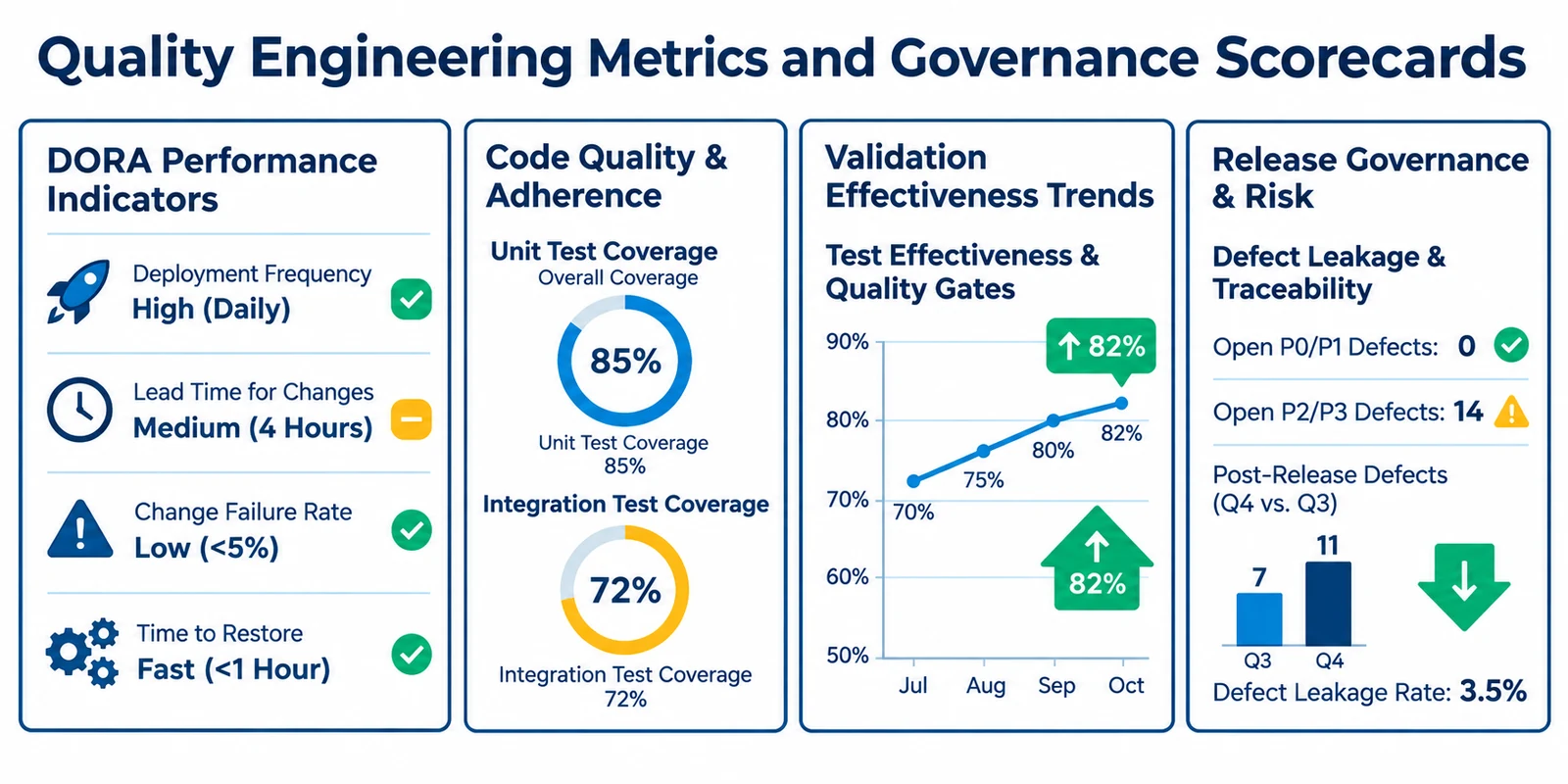
Coverage and pass rates alone can give a false sense of security. Governance must also assess whether tests exercise meaningful business risks and whether their results are stable enough to support decisions. Applied together with DORA metrics, these thresholds give leadership a single scorecard for quality and delivery:
Measuring AI Effectiveness
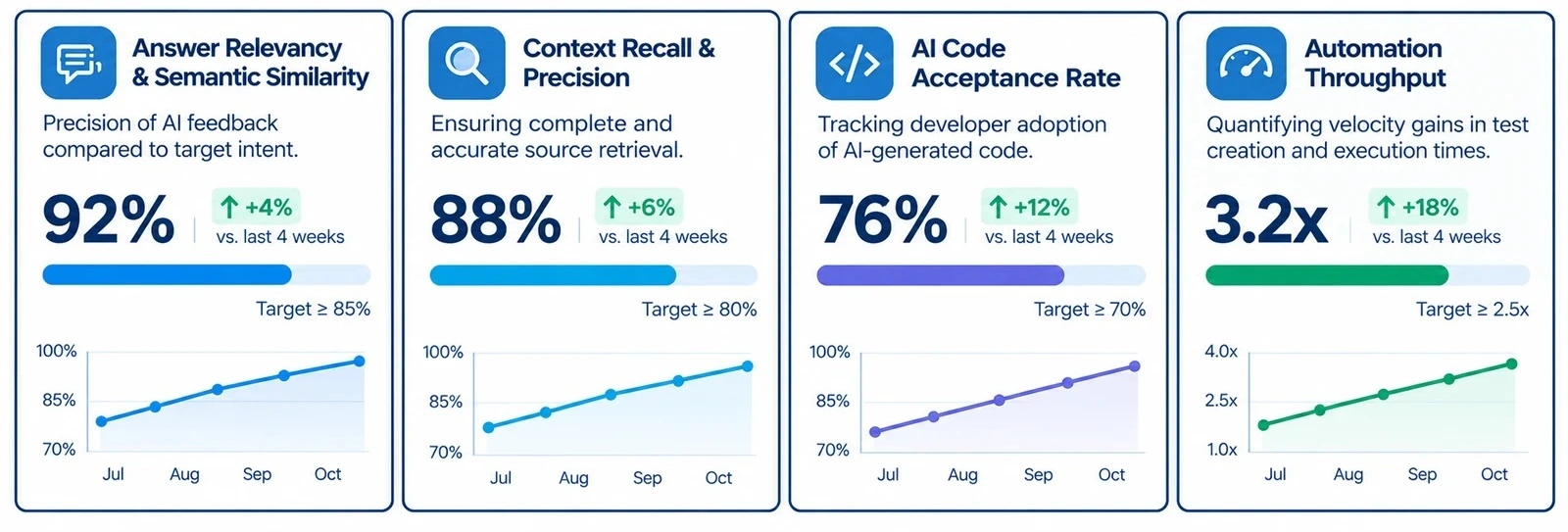
Beyond traditional software quality and throughput metrics, engineering leaders evaluate AI performance using specialised benchmarks that assess textual precision, context retrieval accuracy, and long-term developer trust. Incorporating qualitative and algorithmic evaluation loops ensures that AI integration directly improves software reliability without introducing hidden technical debt or hallucinations:
Answer Relevancy & Semantic Similarity. Precision of AI feedback compared to target intent.
Context Recall & Precision. Ensuring complete and accurate source retrieval.
AI Code Acceptance Rate. Tracking developer adoption of AI-generated code.
Automation Throughput. Quantifying velocity gains in test creation and execution times. Measuring time savings highlights operational return on investment across the engineering organisation.
The following dashboard illustrates how these metrics are used to measure AI effectiveness over time:
Breach Remediation & Mitigation Protocols
When AI performance metrics fall below agreed thresholds, immediate corrective protocols must be executed to prevent systematic degradation. Initial breaches trigger specialised evaluation tools to run targeted diagnostic suites and inspect prompt grounding or context retrieval. If the performance gap persists or impacts critical delivery pathways, the corresponding AI capability is temporarily disabled or reverted to human-in-the-loop validation until root-cause remediation and prompt re-benchmarking are completed.
6. Roadmap to Strategic Quality Intelligence
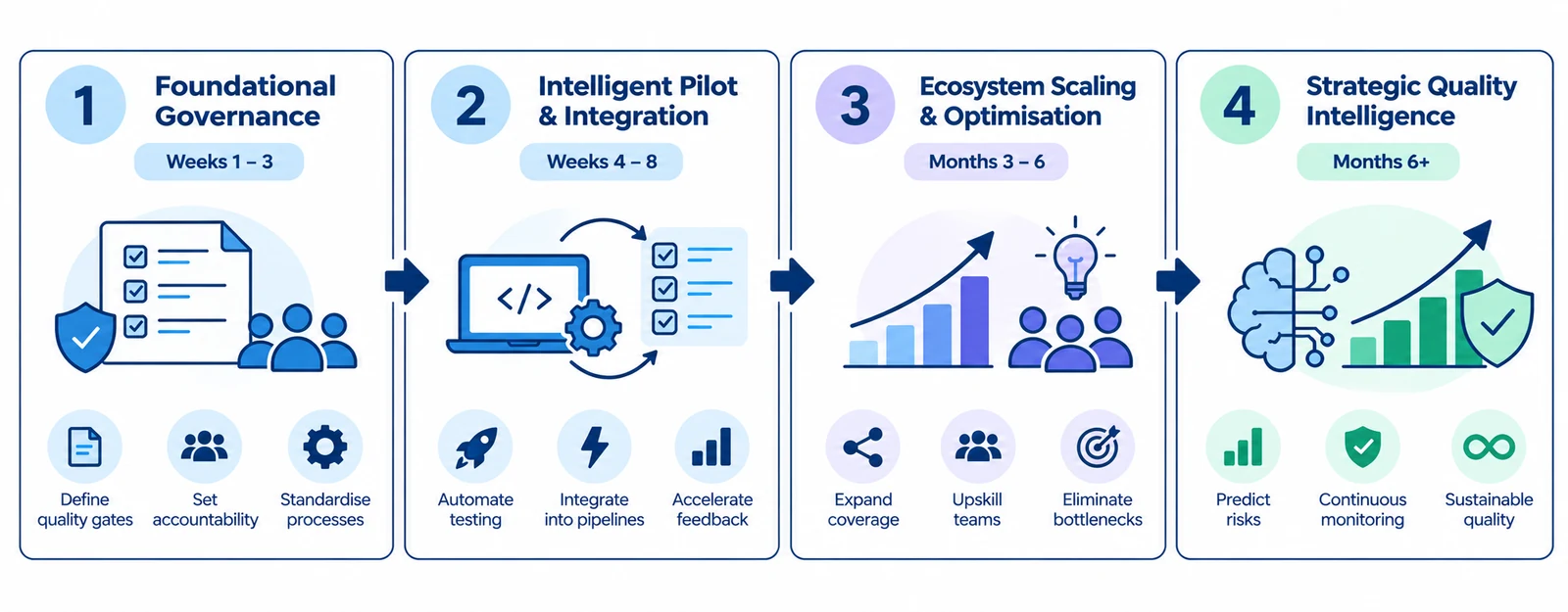
Transitioning to an AI-powered governance model is a multi-phase strategic journey that requires deliberate alignment across technology, culture, and process. Establishing a phased roadmap ensures sustainable adoption, minimising operational disruption while progressively driving higher maturity and quality intelligence across engineering teams.
The phases and timelines outlined below are based on prior engagements with both small and large client organisations. In every case, an initial customisation period following preliminary discovery weeks is required to tailor the roadmap to specific organisational needs.
Phase 1: Foundational Governance & Capability Alignment.
- Approach: Establish centralised system-of-record governance, formalise mandatory quality criteria at key SDLC gates (Definition of Ready / Definition of Done), and define clear organisational accountability across all engineering roles.
- Objectives: Standardise baseline processes, eliminate untracked off-system work, and align cross-functional engineering teams around objective operational quality gates.
Phase 2: Intelligent Pilot & Verification Integration.
- Approach: Introduce automated verification frameworks and intelligence-assisted quality workflows directly into active development sprints to automate repetitive testing overhead and pipeline execution checks.
- Objectives: Accelerate developer feedback loops, reduce early-stage manual validation effort, and validate automated quality checks within live deployment pipelines.
Phase 3: Ecosystem Scaling & Process Optimisation.
- Approach: Expand continuous quality coverage across all critical product workflows, upskill engineering teams on modern quality architectures, and cultivate an organisational Quality Community of Practice.
- Objectives: Achieve widespread coverage of critical workflows, institutionalise shared quality standards, and systematically eliminate cross-team operational dependencies and bottlenecks.
Phase 4: Strategic Quality Intelligence & Continuous Maturity.
- Approach: Transition to a proactive, continuous quality intelligence model powered by predictive risk analysis, autonomous verification, and continuous performance and compliance monitoring.
- Objectives: Maintain ecosystem stability (≥80%) and automated pass rates (≥90%), achieve near-zero post-release defect leakage, and establish a self-sustaining culture of engineering excellence.
The following roadmap outlines the multi-phase progression toward continuous quality intelligence, mapping organisational maturity against key implementation milestones over time:
Conclusion
AI-powered governance reframes software quality as a continuous, organisation-wide responsibility. It connects clear ownership and objective quality gates with traceable evidence, layered testing, and measured AI performance.
By shifting verification upstream and keeping AI outputs subject to explicit controls, organisations can reduce defect leakage while preserving delivery speed. A single source of truth, accountable owners, transparent thresholds, and defined remediation paths help ensure that automation strengthens, not obscures, quality decisions. The result is a more predictable approach to delivery in which quality is governed throughout the lifecycle, rather than inspected only at the end.
References
[1] ISO/IEC/IEEE 29119-1:2022. Software and systems engineering, Software testing, Part 1: General concepts. iso.org/standard/81291.html
[2] UNE-EN ISO/IEC 42001:2026. Standard on Artificial Intelligence Management Systems. iso.org/standard/42001
[3] DORA. AI Capabilities Model. dora.dev/ai
Related Parser insights